Showing posts with label poll. Show all posts

Sunday, August 11, 2013

Americans tell pollsters: Fire the entire Congress!


It is often noted that even though the vast majority of voters support term limits, they will also reelect their own representative over and over and over again.
This is less of a contradiction than it may appear on first glance.  Term limits are an institutional reform that affects the legislative bodies’ makeup and incentives and also who ultimately appears on ballots. That is very different than choosing between two or three candidates to fill a public post in particular election.
When voting to fill a post, voters look at the choices and pick the best one – or, in most cases, the least bad one.  In many cases, that may be the incumbent. After all, the odds are high the opponent is not a serious one.  In an environment where incumbents win their own seat in general elections some 95% of the time, serious goal-oriented people rarely run for office against them.
Hence, either incumbents go unopposed or they attract unqualified, even if well-meaning, opponents. These opponents are usually underfunded and are not even backed by their own political party. After all, with scarce resources, why would a party spend real money on unwinnable seats?
Meanwhile, the incumbent is a statistical sure thing and a great investment for special interest money and muscle.
Gerrymandering also plays a role.  In safe seats where one party dominates, the likelihood is high that voters will simply pull the lever for their party’s nominee.
Voters seem to understand this better than pundits.  In an NBC News/Wall Street Journal on July17-21, voters were asked:

"If there were a place on your ballot that allowed you to vote to defeat and replace every single member of Congress, including your own representative, would you do this, or not?"

57% said ‘yes.'
Well, there isn’t such a place on the ballot. Instead, voters are asked to choose from a list of candidates – chosen through a flawed process skewed towards the incumbency – and they hold their noses and pull the lever once again. The old power brokers return to office and nothing ever changes. How could it?
No, the voters don’t love their incumbents. The same poll showed 83 percent of voters disapprove of Congress, a new record. Voters want competitive elections and rotation in office. They want term limits.

Monday, February 15, 2010

Only 8% of Americans want Congress reelected

According to a new poll by CBS News and the New York Times:

  • 8 percent of Americans want the members of Congress reelected.
  • 80 percent of Americans said members of Congress are more interested in serving special interests than the people they represent.
  • 75 percent disapprove of the job Congress is doing.

These numbers complement perfectly the latest (October 2008) national polling that shows that 83 percent of Americans support term limits on their elected officials. All show a bi-, tri- and non-partisan yearning of the American people for the lost tradition of rotation in office that our Founders intended.


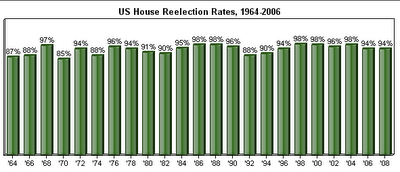
So this means that incumbents will get clobbered in the 2010 elections? Well, maybe, but history shows that nearly all the change will occur in competitive open seat elections. Even in the dramatic years of change, such as 1992-94 and 1996-98 (see chart above), Congressional incumbents won overwhelmingly in spite of the mood of the country that showed up clearly in competitive races.

Please note the Massachusetts message was only made possible by the opening up of Sen. Ted Kennedy's seat. In other anticipated upsets -- Rand Paul in Kentucky and Marco Rubio in Florida, for example -- it is the open seats that are giving voters their voice.

Only an institutional reform like term limits can fix the institutional problem of entrenched incumbency. In the meantime, voters can take advantage of open seats as they occur to meaningfully express their will. But with term limits, it will not require crisis, retirements and luck to effectuate change. Instead, there will be rolling open seats in every district in the nation, drastically improving the people's representation on a regular basis.

(Thanks to the Center for Responsive Politics for the image above.)

Wednesday, November 26, 2008

Filipinos frown on term limits repeal

The dateline for this one is Manila, but it could be Caracas or even New York City. It is a universal and eternal fact of life that citizens love terms limits and incumbent politicians hate them.

The latest datum is a new poll from the Philippines, where a move is afoot to lengthen or repeal term limits for the president, vice president and the legislature as part of a package of constitutional changes. Outside the capitol building, only 15 percent of the population approve of weakening term limits, according to a new Social Weather Stations poll. A full 64 percent oppose it.

Currently, the constitution mandates term limits at nearly all levels. For a survey of international term limits, see LINKS in the left-hand column on this blog.

Friday, November 21, 2008

Mayor Bloomberg's popularity dives

A new poll shows that Michael Bloomberg's popularity has dropped nine percent due primarily to the New York City mayor's self-interested tinkering with term limits.

Claiming that his leadership is indispensible to lead New York City through the current financial crisis (there being so few financially savvy people in New York City, I suppose), Bloomberg prodded his city council on Oct. 23 to lengthen his -- and the council's -- term limit from two to three terms. This was after two popular referenda to enact then affirm them.

As a result, Bloomberg's approval rating has dropped to its lowest point in three years. A new Marist poll shows 59 percent of voters think he is doing an excellent or good job, down from 68 percent a month ago. It's the first time his popularity has fallen below 60 percent since August 2005.

This is still high, but next he has to answer for his arrogance throughout a electoral campaign amidst a difficult economic environment in which he is raising taxes substantially. Bloomberg's numbers will come tumbling down and it was term limits that pushed him off the top of the hill.