Showing posts with label Congress. Show all posts

Monday, October 21, 2013

OBIT: Ex-Speaker Thomas Foley's term expires

by Paul Jacob via Town Hall

We never met. Even if we had met, we wouldn’t have been friends: we wouldn’t have traded holiday cards, certainly wouldn’t have shared a drink or played tennis or joked together at a party. (I wonder if he played tennis.)

Former Speaker of the House Thomas S. Foley (D-Wash.) passed away on Friday at age 84. We were political antagonists, twenty years ago, when the issue of term limits placed us at loggerheads.

It wasn’t personal. Foley was just another congressperson to me, though his 30 years in Congress and his leadership position obviously made him more answerable for the then-high levels of congressional arrogance and dysfunction — which seem so much less toxic now, in retrospect, because of the passage of time and the fresh memories of current congressional malevolence.

In those days, I served as executive director of U.S. Term Limits, and was campaigning to place limits on the number of terms any person could spend in Congress. The idea was to disable politicians from holding power for decades without ever having to return home to live under the laws they had passed.

Back then Congress exempted itself from many of the laws it enacted. That practice has noticeably changed, as sometimes now the president must also be called in to exempt Congress from the laws it passes, as with Obamacare.

In 1992, working with citizen leaders in 14 states, we petitioned to place term limits initiatives on the ballot — the most states to ever vote on a single issue in the same election cycle. Voters in all 14 states approved term limits, including in Speaker Foley’s home state of Washington.

Washington’s Initiative 573 lost narrowly in Foley’s congressional district, but won statewide. The voters had spoken and, though the Speaker was returned to office for the next term, he was also now limited to no more than three additional terms, six years.

So, Speaker of the House Tom Foley sued in federal court to overturn the vote cast by the people of his state imposing term limits on him. It was neither the first nor the last time a politician sued his voters, but few campaign managers recommend it. Being a plaintiff in the lawsuit against term limits proved Speaker Foley’s undoing, a misstep from which he could not recover.

Foley and his spokespeople often cited the fact that folks in his district had sided against the term limits measure. True, but even among that very slim majority, his lawsuit to overturn the people’s vote felt like a slap in the face and was seen as an unmistakable sign Mr. Foley had “gone Washington.”

The other Washington.

As the 1994 election approached, congressional Republicans were embracing term limits in their Contract with America, and so was a young lawyer from Spokane named George Nethercutt, who was challenging Speaker Foley. Nethercutt not only claimed to favor term limits, he pledged to serve just three terms, as Washingtonians had voted, and he promised never to sue his constituents as Foley was doing. The term limits movement spent more than $300,000 on TV and radio spots and mailings reminding eastern Washington voters of all that Foley had done to deny their vote and block his own term limits.

On that election night some nineteen years ago, Tom Foley’s opposition to term limits made him the first Speaker of the House since the Civil War to be defeated for re-election. Historically, sitting speakers have been rarely defeated. In modern times, with the power of incumbency, it had never happened.

Galusha Aaron Grow, a Radical Republican from Pennsylvania, was the last speaker so turned out back in 1862, after a dozen years in Congress . . . but just a single term as House speaker. Ironically, Grow had replaced William Pennington, a New Jersey Republican who was defeated for re-election in 1860 after serving his only congressional term — the last portion of which he was installed as a compromise speaker.

Not much has been made of George Nethercutt’s amazing victory in 1994, because Nethercutt broke his word, refusing to step down from office after three terms.

Much is made of Foley’s historic defeat, however. In recognizing the passing of the former Speaker, Reuters reported that, “a conservative mood shift made him one of the few speakers ever defeated for re-election.” Time noted that, “Foley wasn’t the victim of scandal or charges of gross incompetence.”

Well, yes and no. Not “scandal” in a criminal way — or the X-rated sense that politicians are so fond of providing to a mass audience these days. But for the voters of eastern Washington, suing to overturn their vote for term limits was politically scandalous, indeed. (Personally, I like their standards.) As the Seattle Times explained in remembering the man, “Few things unleashed the ire of Mr. Foley’s constituents as much as his dogged campaign against term limits.”

Though he was wrong about term limits and I was right, let me say after 20 more years of experience that I like Mr. Foley’s style. He seemed a happy warrior, never inspiring personal animosity. Hey, in politics, that’s saying something.

Memories of Speaker Foley spark in me a remembrance of what the people of eastern Washington did at the polls some twenty years ago. Those voters certainly did not want to let a nice man like Tom Foley go. But neither could they countenance his lawsuit. They were not swayed in the least by the lavish gifts a Speaker of the House could bestow on their area, and instead, they voted, heroically, to fix the broken Congress.

May Speaker Foley rest in peace. And may none of the rest of us rest until we again have a Congress that truly represents the American people.
 
Paul Jacob is president of Citizens in Charge Foundation and Citizens in Charge and former executive director of U.S. Term Limits. His daily Common Sense commentary appears on the Web and via e-mail. This piece originally ran on the Town Hall website on Oct. 20, 2013.

Sunday, August 11, 2013

Americans tell pollsters: Fire the entire Congress!


It is often noted that even though the vast majority of voters support term limits, they will also reelect their own representative over and over and over again.
This is less of a contradiction than it may appear on first glance.  Term limits are an institutional reform that affects the legislative bodies’ makeup and incentives and also who ultimately appears on ballots. That is very different than choosing between two or three candidates to fill a public post in particular election.
When voting to fill a post, voters look at the choices and pick the best one – or, in most cases, the least bad one.  In many cases, that may be the incumbent. After all, the odds are high the opponent is not a serious one.  In an environment where incumbents win their own seat in general elections some 95% of the time, serious goal-oriented people rarely run for office against them.
Hence, either incumbents go unopposed or they attract unqualified, even if well-meaning, opponents. These opponents are usually underfunded and are not even backed by their own political party. After all, with scarce resources, why would a party spend real money on unwinnable seats?
Meanwhile, the incumbent is a statistical sure thing and a great investment for special interest money and muscle.
Gerrymandering also plays a role.  In safe seats where one party dominates, the likelihood is high that voters will simply pull the lever for their party’s nominee.
Voters seem to understand this better than pundits.  In an NBC News/Wall Street Journal on July17-21, voters were asked:

"If there were a place on your ballot that allowed you to vote to defeat and replace every single member of Congress, including your own representative, would you do this, or not?"

57% said ‘yes.'
Well, there isn’t such a place on the ballot. Instead, voters are asked to choose from a list of candidates – chosen through a flawed process skewed towards the incumbency – and they hold their noses and pull the lever once again. The old power brokers return to office and nothing ever changes. How could it?
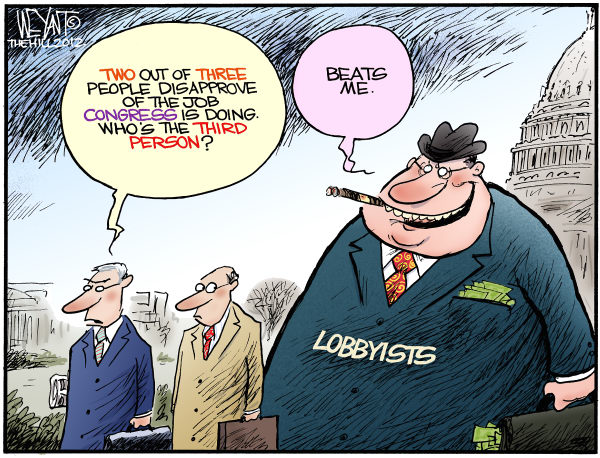
No, the voters don’t love their incumbents. The same poll showed 83 percent of voters disapprove of Congress, a new record. Voters want competitive elections and rotation in office. They want term limits.

Sunday, February 24, 2013

DeMint may be gone from Senate, but term limits bill isn't

When Sen. Jim DeMint of South Carolina announced his retirement from the Senate, term limits activists were worried. After all, it was DeMint's name on the Congressional term limits bill.

But on Jan. 22, Sen. David Vitter (R-LA) introduced an amendment to the U.S. Constitution which would limit the number of terms that a Congress member may serve to three in the House of Representatives and two in the Senate. That is, the same bill.

DeMint may not be done with term limits. He left the Senate to take the helm at the Heritage Foundation where he can be enormously influential in advancing the issue. With the Cato Institute firmly behind the reform, there may be another policy powerhouse on the term limits case.

Sen. David Vitter has reintroduced the Congressional term limits bill in the Senate and a House companion bill is expected imminently.

Term limits for members of Congress has been spotlighted in recent weeks as former Senator and Vice Presidential nominee Joe Lieberman announced that after reflection on his 24 years in office that he now supported term limits.

The Lieberman statement was followed by a polls conducted by the Gallup Organization released in January showing that the American people would vote for congressional term limits by a 75 – 21 margin.

To become part of the U.S. Constitution, the amendment requires a two-thirds vote in each house of Congress and ratification by three quarters or 38 out of 50 states. This will not happen without pressure from us. Please sign the online petition now.

Saturday, October 6, 2012

Incumbents Ribble, Mulvaney join term limits team

Over the past year, the mailbox at the U.S. Term Limits offices in Fairfax, Va., has been filling up with signed pledges (over 188 so far) from Congressional candidates that promise to cosponsor and vote for 3/2 term limits bills like those introduced by Sen. Jim DeMint of South Carolina and Rep. David Schweichert of Arizona.

But over the last week or so we've been pleased -- maybe a bit surprised -- to find written commitments from a couple of incumbents.

The first arrived from Rep. Mick Mulvaney of South Carolina's 5th Congressional District, a signed U.S. Term Limits pledge. Interestingly, Rep. Mulvaney didn't support term limits until he was elected, an unusual phenomenon. As the second-term Congressman notes on his website, "Before I got into government I opposed term limits ... Having seen government up close, I have learned my lesson. I support term limits."


Welcome aboard!

Then we received a letter from Wisconsin's Rep. Reid Ribble, 8th District, in which he pledges support for 3/2 term limits legislation and offers an idea for getting it done.

"As you are aware, I am a firm believer in term limits for Congress. I believe many of the systemic problems that our government faces would be reduced or eliminated if politicians did not make their time in Congress a career."

Rep. Ribble notes that the big hurdle is getting Congress members to term limit themselves, so he suggests that a grandfather clause be added to get it through Congress. If this is enacted, he writes, "Over time, serving in Congress will again be a privilege, not  a career, similar to the way the Founding Fathers originally intended."

Mulvaney and Ribble join a growing minority of incumbents on the Hill taking action on this issue. After November, as our stack of pledges indicate, there will be a lot more.

 (Top left, Rep. Reid Ribble's term limits letter; Right, Rep. Mick Mulvaney)

Thursday, August 16, 2012

Term limits ad propels veterinarian past veteran Florida Congressman


Yet another political newcomer has left a professional politician in the dust -- and he used a hilarious term limits ad to do it.

Rep. Cliff Stearns of North Central Florida's 3rd District, which includes Gainesville, was a big spending Republican with a social conservative bent. His 24-year spending record proved to be his weak spot after large animal doctor Ted Yoho highlighted it in the best TV ad so far in the 2012 election season.


The ad features WWE wrestler Dustin (Rhodes) Runnels and shows professional politicians in suits eating from a pigs' trough and throwing mud at one another. At the end, Yoho pledges to serve eight years and come home.

Stearns had been endorsed by Republican bigwigs including Rep. Paul Ryan. Yet Yoho, who raised very little money, unexpectedly won the election by about 800 votes.

Yoho will face Democrat J.R. Gaillot in the general election, but the seat is considered safely Republican. It looks like another term limits supporter is going to Washington.

Wednesday, August 1, 2012

Cruz win in Texas another leap ahead for Congressional term limits

By the end of the campaign, it appeared Congressional term limits would be the winner regardless of whether Lt. Gov. David Dewhurst or Ted Cruz won the GOP nomination for Texas' U.S. Senate seat last night.

After all, after Ted Cruz signed the U.S. Term Limits pledge to cosponsor and vote for 3/2 term limits legislation if elected, Dewhurst did the same. They are two of the 187 Congressional candidates to do so in the 2012 election cycle.

But since then, Cruz has been broadcasting his support for term limits and even mentioning the U.S. Term Limits pledge on national television. Dewhurst, on the other hand, started distancing himself from his pledge -- and victory. Less than three weeks later Dewhurst was proposing a package of election reforms that directly contradicted the pledge he had signed.

It is easy to support term limits as a challenger and difficult as an incumbent, with both party leadership and your own personal self-interest pressuring you to chuck your promise. Under these circumstances, the enthusiasm for Congressional term limits demonstrated by Cruz suggests that Sens. Jim DeMint, Rand Paul, Tom Coburn and the other term limits stalwarts in the U.S. Senate have won another important new ally and cosponsor.

Sen. DeMint's term limits amendment bill, SJR 11, would require a two-thirds majority vote in the House and Senate, and ratification by 38 states in order to become part of the Constitution. For more information on the pledge, including a list of signers, see here.

Tuesday, June 19, 2012

Michigan House veteran losing ground to term limits crusader Jack Hoogendyk


Wow. Yet another term limits supporter is closing in on a establishment veteran in a GOP primary. In Michigan's 6th House district, Jack Hoogendyk is seen as a contender against 25-year incumbent Fred Upton.

As in the other matchups -- Massie in Kentucky, Mourdock in Indiana -- the challenger comes armed with a signed U.S. Term Limits Congressional pledge and the incumbent awkwardly tries to defend his long tenure during which government spending and debt ballooned.

Upton is a classic foil. As illustrated in a famous Cato Institute study, Republicans tend to arrive in Washington and more or less live up to their fiscal conservative rhetoric -- for a while. But after 6, 7, 8 years their spending ramps up and soon they are no longer distinguishable from the veteran spenders.

Indeed, Upton received all As and Bs from the National Taxpayers Union during his first decade in Washington. But over his second decade he received mostly Cs, even a C-.  Like so many Republican candidates before him Fred came to Washington to cut government and eventually decided that the federal government should be in charge of everything from the weather, to Iraqi road maintenance, to kids video games. He has become part of the problem.

Like all longtime incumbents, he announces his reelection campaign and his coffers fill up automatically, as nearly all PAC contributions go to incumbents who have proven themselves as reliable spenders. In the first quarter, Upton raised nearly $1 million with big checks from the very firms he oversees as chairman of the House Committee on Energy and Commerce: Entergy, Southern Company, Murray Energy, Duke Energy, Nuclear Energy Institute, etc. Of course, what would you expect? That's how the system works.

In the other corner we have Jack Hoogendyk. A tea partier and a member of the Campaign for Liberty, Hoogendyk focuses on spending and debt and has pointed to Rand Paul's proposed budget as an outline to follow to get spending under control. As a USTL pledge signer, he has committed himself to, if elected, cosponsor and vote for a 3/2 Congressional term limits amendment such as that introduced by Rep. David Schweikert of Arizona.

The Schweikert bill -- the house companion of Jim Demint's Senate bill -- is the first serious bill since the 1990s with co-sponsorship in both houses of the Congress. So far, there are about 10 cosponsors each in both the House and the Senate.

Rep. Fred Upton is not one of them. But Indiana Republicans have the opportunity to nominate someone who will be.

(Pictures: At top left , Rep. Fred Upton and challenger Jack Hoogendyk debate; At bottom right, GOP leadership enforcers keep Upton on track: Spend, spend, spend...)

Thursday, May 31, 2012

Texas U.S. Senate candidate Ted Cruz on the U.S. Term Limits Pledge

"I have no interest in being in office for decades. I strongly support term limits. And in fact I have committed to cosponsor a constitutional amendment to limit every member of the U.S. Senate to two terms, every member of the House to three terms. That fight being led right now by Jim Demint ... Mike Lee, Rand Paul, Pat Toomey and Tom Coburn ... they need reinforcements." -- Texas U.S. Senate Candidate Ted Cruz on the U.S. Term Limits Congressional Pledge during a Fox News interview on May 31. Cruz is one of 176 Congressional candidates to sign the pledge so far.

Friday, May 25, 2012

In Kentucky, another primary win for term limits


Don't look now, but term limits have scored another win in this primary cycle. Following the historic upset in Indiana, Kentucky also has nominated a term limits warrior for a Congressional seat. On Tuesday, political newcomer Thomas Massie beat out a group of establishment Republicans to win his party's nomination for the open 4th District House seat.

Massie is a signatory of the U.S. Term Limits Congressional Pledge, in which he has committed to cosponsor and vote for a Congressional term limits amendment along the lines of that proposed in the U.S. Senate by Sen. Jim DeMint (R-SC) and the House by Rep. David Schweikert (R-AZ).

Massie ran as a libertarian reformer in the mold of Kentucky's junior senator, Rand Paul, who endorsed him. The party establishment, still unable to fathom Sen. Paul's success, is missing the ascent of Massie as well. Massie's chief opponent, Alecia Webb-Edgington, told a Kentucky Lincoln Day Dinner in 2010 that "We don't need any more socialists, communists or libertarians in the Republican Party." The party hacks at that meeting clapped, but Republican voters ignored them and nominated Massie anyway.

Massie is one of 173 Congressional candidates -- so far -- who have signed the USTL pledge. The media hasn't picked up on this story yet, but term limits are back on the national stage.

(Pictured: Congressional candidate Thomas Massie with Sen. Rand Paul)

Friday, May 11, 2012

Indiana Senate upset a big victory for term limits


USTL President Philip Blumel with Richard Mourdock in IN
The May 8 victory of Richard Mourdock in the Indiana Republican primary for U.S. Senate is being cast as a victory of the tea party over the establishment. Indeed it was.

But it was something else too: another step down the path to achieving Congressional term limits.

Mourdock, it turns out, is one of the 167 Congressional candidates -- so far -- who have signed the U.S. Term Limits pledge to, if elected, cosponsor and vote for a Congressional term limits amendment. He is an explicit supporter of Sen. Jim DeMint's Congressional term limits amendment bill, SJR 11, which Mourdock said he plans to cosponsor.
Sen. Richard Lugar

For this reason, I spent a couple of days on the road with Mourdock in the final week of the primary campaign. In joint appearances across the state, I told the term limits story and announced the endorsement Mourdock received from the Term Limits America PAC.

In dissecting Mourdock's victory, pundits are pointing to a gaggle of issues directly related to term limits as the decisive factor in the last minute surge of support for Mourdock.

Mourdock's opponent, the 36-year incumbent Senator Richard Lugar, is 80 years old, has not lived in Indiana for years and has not faced an opponent in 12 years -- or a meaningful one for much longer. He was a respected figure in the bipartisan spending and foreign policy consensus of the last generation and was seen as out of touch with the new energetic breed of activist-candidates fueled by what they see as a looming debt crisis. In a February "Sense of the Senate" vote on Congressional term limits, Sen. Lugar voted 'no.'

Mourdock, on the other hand, is 60 years old and as Indiana's state treasurer had sued the Obama administration over its bailout and extra-legal reorganization of Chrysler. He had self-limited his terms as a county commissioner earlier in his career and has done so again for the U.S. Senate, promising to serve just two terms. Mourdock also had a 30-year career as a geologist and businessman and can claim to offer some real world experience to the Senate.

There is a changing of the guard in the U.S. Senate. The newcomers -- Sens. Rand Paul, Mike Lee, Marco Rubio, JimDemint, Tom Coburn and others -- are on board with term limits, while the dinosaurs they are replacing are the ones who stood in term limits way.

Hopefully after November we can add Richard Mourdock to that list.

Sunday, February 12, 2012

U.S. Senate votes down DeMint term limits resolution 24-75

It was a clear defeat, and a predictable one, but the fact the vote was held at all was a clear victory in bringing this issue back to the fore.

Recent uproar about insider trading by Congress members and their staffs led to a vote on the so-called STOCK Act to explicitly prohibit such activity. The STOCK Act easily passed the Senate and a House version passed soon after. But the attention given to Congressional soft corruption invited amendments to deal with more fundamental issues such as earmarking and, yes, Congressional term limits.

Sen. Jim DeMint (R-SC), chief sponsor of the Congressional term limits amendment bill, used this opportunity to add a "Sense of the Senate" amendment calling for a vote on whether Congressional terms should be limited. The amendment failed 24-75 on Feb. 2.

Check to see how your Senator voted here.

The breakdown of the votes is interesting. Note that three-quarters of the Senate opposes term limits. This is a near mirror image of the public, three-quarters (or more) of which support term limits in polls and at ballot boxes. This clearly shows how opposite the interests of incumbent politicians as a class are from the electorate. It is this class interest that makes institutional protections of voters such as term limits so important.

Currently, U.S. Term Limits is approaching all the YEA voters and urging them to walk the talk. Only about a third of those who voted for DeMint's Sense of the Senate resolution are cosponsors of his Term Limits for All amendment bill.

Clearly, we have a lot of work to do. But with polling on term limits at all-time highs, term limits bills in both Houses of Congress, 99 signatories on the USTL Congressional term limits pledge, a vote on the Senate Floor and even a rival bill being floated to sabotage term limits in the House, you can see things are moving on this issue.

If you haven't yet, be sure to sign the USTL online petition calling for Congressional term limits here. Let Congress know how you would have voted on that Senate resolution!

Wednesday, September 14, 2011

Turner win in NY a victory for Congressional term limits

This morning's press release tells the story:

SEPTEMBER 14, 2011 -- U.S. Term Limits President Philip Blumel celebrated the victory of Bob Turner to the U.S. House in yesterday’s special election in New York’s 9th as a victory for the cause of Congressional term limits.

"We welcome yet another new face in Washington who is committed to opening up the Congress to citizen legislators like himself," said Blumel. Turner is a retired media executive of 40 years.

A Constitutional amendment bill has been introduced by Rep. David Schweikert (R-AZ) in the U.S. House of Representatives and Senator Jim DeMint (R-SC) in the U.S. Senate which limit members of the House to three terms and Senators to two terms in office. Turner is a signatory of a U.S. Term Limits pledge to support such legislation.

"Turner’s upset election in is just one more shock wave to hit the power structure in D.C. People are demanding an end to the entitled political culture in our nation’s capitol and passage of the term limits Constitutional Amendment would be a great leap towards that goal,” Blumel said. “We look forward to seeing Rep. Turner’s name on the growing list of cosponsors for the term limits amendment."

To sign an online petition in favor of the term limits amendment, go here.

Term limits continues to enjoy broad, bi-partisan support with 78% of U.S. registered voters in favor of congressional term limits according to a September 2010 FoxNews Public Opinion Dynamics poll of registered voters. The poll showed 74% of Democrats polled favored term limits with 84% of Republicans indicating support, with overall support jumping 8% from a March 2009 poll.

Passage of the Constitutional Amendment requires a 2/3 vote of both the U.S. Senate and House of Representatives followed by passage in 38 states.

Monday, September 6, 2010

Term Limits and the 2010 U.S. Senate elections

The issue of term limits is hot again, in a way we haven't seen in well over a decade. A poll released last week shows that 78 percent of Americans support term limits for the U.S. Congress, including large majorities for Democrats (74%), independents (74%) and Republicans (84%). Meanwhile, Congressional approval ratings are mining all-time lows.

Hence, now is the time to press for Congressional term limits. If not now, when?

We have a vehicle, the "Term Limits for All" amendment, with leadership from its author, Sen. Jim DeMint. What we need now is get more cosponsors and votes for the amendment. That means electing pro-term limits candidates. Just as importantly, it means getting these candidates to commit to co-sponsoring the DeMint amendment.

Why is this specific bill so important? Because supporting term limits in general but then opposing the specific proposal that is actually on the table is the oldest political trick in the book. We need to approach all Senate candidates with the follwing question, either in conversation, at public appearances, or by phone or email: "Will you become a co-sponsor of the DeMint amendment to limit Congressional terms?" Then we need to help them win.

ALASKA -- JOE MILLER

The Miller campaign informs us that he has spoken in support of term limits, but has not made the issue central to his campaign. They are looking at the DeMint amendment and will decide whether or not to come out in support.

CALIFORNIA -- CARLY FIORINA

Firoina made a big splash with her announcement to support term limits for the U.S. Congress. The problem is, the 12-year House limits she is calling for don't jibe with DeMint's amendment, which calls for six years for the House and 12 for the Senate. Thank her for her support of term limits, but will she sign on to the DeMint bill? Ask her!

COLORADO -- KEN BUCK

Buck is one of the eight Senate candidates being financially assisted by DeMint's Senate Conservatives Fund. One of the eight planks of the CSF is "Our country is being destroyed by career politicians. SCF candidates will support a constitutional amendment establishing congressional term limits. " That is a good sign and Buck has verbally supported term limits. But will he be a co-sponsor of the DeMint bill?

FLORIDA -- MARCO RUBIO

Another CSF recipient who has opined that the Republican Party should be the party of term limits. However, he has gone to great lengths to avoid committing to supporting Jim DeMint's bill in public. In fact, he has gone quiet on the issue since he successfully used his Tea Party stepladder to become the establishment favorite.

KENTUCKY -- RAND PAUL

Term limits is one of Rand Paul's top campaign issues and he has unambiguously come out in support of the DeMint bill. He has even pledged to work on trying to make term limits a presidential issue for 2012! Thanks, Rand.

OKLAHOMA -- TOM COBURN

Tom Coburn is a long-term term limits supporter and is already a co-sponsor of the DeMint bill. Thank you!

PENNSYLVANIA -- PAT TOOMEY

One can't doubt Toomey's term limit bona fides. Like Tom Coburn, Toomey left the House after fulfilling a self-imposed commitment to serve no more than eight years in the U.S. House. Today, he is supporting Congressional term limits. Will be be a co-sponsor of the DeMint bill? Ask him!

SOUTH CAROLINA -- JIM DEMINT

Jim DeMint is providing the national leadership needed on this issue. He is also spoken of as a presidential candidate for 2012 or beyond. If he runs, he'd be taking the term limits issue with him on the campaign trail.

Regarding Congressional term limits, some say, "It is a great idea, but it will never happen." Heck, I've said this before! But picture this: 1) 78% support from Americans of all parties, 2) Congressional approval ratings at all-time lows, 3) an amendment bill in the U.S. Senate with a growing list of cosponsors, 4) a companion bill submitted in the House, 5) term limits become important campaign issue across the country, and then, 5) presidential sponsorship.

All of a sudden, it seems like it can happen, doesn't it? Let's make it so!

(By the way, if you have info about these or other Senate races in regards to term limits, please share. You can email me here.)

Monday, February 15, 2010

Only 8% of Americans want Congress reelected

According to a new poll by CBS News and the New York Times:

  • 8 percent of Americans want the members of Congress reelected.
  • 80 percent of Americans said members of Congress are more interested in serving special interests than the people they represent.
  • 75 percent disapprove of the job Congress is doing.

These numbers complement perfectly the latest (October 2008) national polling that shows that 83 percent of Americans support term limits on their elected officials. All show a bi-, tri- and non-partisan yearning of the American people for the lost tradition of rotation in office that our Founders intended.


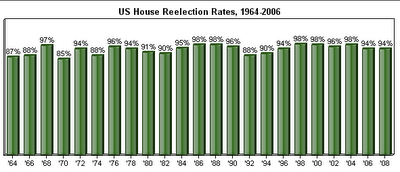
So this means that incumbents will get clobbered in the 2010 elections? Well, maybe, but history shows that nearly all the change will occur in competitive open seat elections. Even in the dramatic years of change, such as 1992-94 and 1996-98 (see chart above), Congressional incumbents won overwhelmingly in spite of the mood of the country that showed up clearly in competitive races.

Please note the Massachusetts message was only made possible by the opening up of Sen. Ted Kennedy's seat. In other anticipated upsets -- Rand Paul in Kentucky and Marco Rubio in Florida, for example -- it is the open seats that are giving voters their voice.

Only an institutional reform like term limits can fix the institutional problem of entrenched incumbency. In the meantime, voters can take advantage of open seats as they occur to meaningfully express their will. But with term limits, it will not require crisis, retirements and luck to effectuate change. Instead, there will be rolling open seats in every district in the nation, drastically improving the people's representation on a regular basis.

(Thanks to the Center for Responsive Politics for the image above.)

Tuesday, November 10, 2009

TERM LIMITS FOR ALL amendment introduced!


It's official. Sen. Jim DeMint has introduced a bill to amend the U.S. Constitution to limit the terms of the U.S. Congress.

If the proposal becomes law, Senators will be limited to two terms (12 years) and Representatives will be limited to three (six years). The text of the bill and amendment can be found here.

The amendment is cosponsored by U.S. Senators Tom Coburn (R-Oklahoma), Kay Bailey Hutchison (R-Texas), and Sam Brownback (R-Kansas). As an amendment to the Constitution, it would require a two-thirds majority vote approval in the House and Senate and must be ratified by three-fourths of the states.

"Americans know real change in Washington will never happen until we end the era of permanent politicians," said Senator DeMint. "As long as members have the chance to spend their lives in Washington, their interests will always skew toward spending taxpayer dollars to buyoff special interests, covering over corruption in the bureaucracy, fundraising, relationship building among lobbyists, and trading favors for pork – in short, amassing their own power. I have come to realize that if we want to change the policies coming out of Congress, we must change the process itself. Over the last 20 years, Washington politicians have been reelected about 90% of the time because the system is heavily tilted in favor of incumbents. If we really want to put an end to business as usual, we’ve got to have new leaders coming to Washington instead of rearranging the deck chairs as the ship goes down.”

He's right. And now we have some work to do.

First, please call your Senator and ask him or her to become a cosponsor of this amendment. Second, please sign our on-line petition to show your support for Sen. DeMint's amendment. Third, send around the petition link to your friends and family and urge them to sign the petition. Fourth, write a letter to the editor announcing the bill and your support of it. Be sure to include how your Senators stand on the issue.

Our most recent polling shows 83% of Americans support term limits. Hence, this should be a done deal. But our system is broken. This amendment is a big step toward fixing it.

Sunday, November 8, 2009

BREAKING NEWS: Sen. DeMint to drop term limits bill!

Great news: Sen. Jim DeMint (R-SC) will soon be launching a Constitutional amendment bill to limit terms of the U.S. Congress!

I am often asked by reporters and talk radio hosts what it would take to achieve Congressional term limits. It is a big project and will take the right conditions to get the job done.

First, I say, we need the people on our side. Check.

Second, we need historically low approval ratings on Congress. Check.

Third, we need political leadership. Check?

Yes, it looks we finally have that too. The remarks below are excerpted from U.S. Senator Jim DeMint’s podcast of October 22, 2009. Senator DeMint, who voluntarily limited his tenure in the House of Representatives to three terms, is announcing the imminent launch of a bill to Constitutionally limit terms.

Take it away, Sen. DeMint:

"The longer I stay in Washington, the more I have come to realize that the problem in the federal government isn't just the people...it’s the process.

"The system itself is so much more powerful than either party or interest group, let alone one president or congressional leader. In Washington, the rules of the game are rigged—in favor of bigger government, higher taxes, more debt, and the time-honored system of political back-scratching of 'go along to get along.

"The fact is, party doesn’t matter when it comes to reform. If you want to change the policies, you have to change the process. That’s why in the next few weeks I will introduce a new constitutional amendment to limit members of the House of Representatives to three terms (which is six years), and members of the Senate to two terms (which is twelve years).

"As long as members have the chance to spend their lives in Washington, their interests will always skew toward fundraising, relationship building among lobbyists, and trading favors for pork—in short, amassing their own power. Since all that power is going to disappear in a few years anyway, term-limited legislators will be far less likely to make compromises with the system.

"Opponents of term limits say that the nation needs wise and seasoned leaders to lead the nation through crises and find consensus on difficult issues. Well, that’s exactly what we’ve got now.... How do you think it’s working out for us? It wasn’t the People who gave us a 12-trillion dollar debt, trillion-dollar deficits, 100-trillion-dollar long term shortfall in Social Security and Medicare, the Wall Street and auto bailouts, and the health care takeover. It was those wise and seasoned leaders, who enjoy lives of privilege almost wholly immune from the consequences of their policy failures.

"Term limits are not enough, of course. I hope my amendment will eventually be ratified, and then followed by other structural reforms to make our public institutions more transparent and accountable. But term limits are a good start. Because if we really want reform, we all know it’s not enough just to change the congressmen—we have to change Congress itself."

The fourth thing we need to win is for grass roots activists to raise such a clamor that this bill cannot be ignored and Congress members are afraid to vote against it.

So please, right now, go to the U.S. Terms Limits website and sign the on-line petition reiterating Sen. DeMint's call for term limits. And send around the link to all your friends and associates of all political persuasions.

If not now, when?

Wednesday, August 26, 2009

Rand Paul: Like Father, Like Son

Following the announcement earlier this month that incumbent and fellow Republican Jim Bunning is not going to seek reelection, Rand Paul officially declared his candidacy for the U.S. Senate representing Kentucky.

Paul, a 40-something opthalmologist from Bowling Green, has never held political office but he has gained quite a bit of campaign experience from helping his father, Texas Congressman Ron Paul, and name recognition through his leadership of the Kentucky Taxpayers United, an activist organization affiliated with the National Taxpayers Union. He said he would go to Washington as a true citizen legislator.

Like his father, Rand is a supporter of Congressional term limits. In a recent interview with the Liberty Maven blog, he was asked if he supported term limits and whether he was willing to term limit himself. Paul was clear: "I support both a Constitutional amendment and/or legislation if it could be done Constitutionally. Voluntary term limits have not worked because the good Congressmen kept the pledge and went home and the creeps broke their pledges and stayed. Also, only a very small percentage, maybe ten to fifteen, ever were elected with a voluntary pledge." Fair enough.

He is currently leading with this popular message in his stump speeches. Early polling show Paul to be a contender and his fundraising has been phenomenal so far, bringing in over $740,000 in just a few months, including a Kentucky record of $430,000 in one day.

Last year another committed term limits supporter -- Florida's Rep. Tom Rooney -- snuck into Congress. Maybe we'll see another, perhaps many others, in 2010. After all, polls show popular support for term limits at an all-time high and incumbents at a low.

Let's pop this question to all Congressional candidates during the next election cycle: Do you support Congressional term limits?

Thursday, July 9, 2009

Luther Martin, term limits prophet

I am reading an informative and humorous little book called Forgotten Founder, Drunken Prophet: The Life of Luther Martin by Bill Kauffman. Martin was a representative of Maryland at the Constitutional Convention in 1787 and an example -- exasperating to many -- of the so-called anti-federalists who feared the new Constitution would centralize new and nearly unlimited national powers. To protect Americans' liberties, the antis clamored for, among other things, a Bill of Rights and term limits. They got the former but not the latter.

In the debates over term limits, Virginian George Mason -- often called the father of the Bill of Rights -- pointed out that "nothing is so essential to the preservation of a republican government as a periodical rotation."

Martin argued vociferously, as apparently it was the only way he knew how, that the entrenched politician "will take his family to the place where the government shall be fixed; that will become his home, and there is every reason to expect, that his future views and prospects will centre in the favors and emoluments of the general government." It is in lines like these that Luther earned the title 'prophet' in the book's title.

But not only the anti-federalists feared an entrenched incumbency. Federalist G. Livingston of New York imagined the elite life of political lifers thusly:

In this Eden they will reside with their families, distant from the observation of the people. In such a situation, men are apt to forget their dependence, lose their sympathy and contract selfish habits ... The senators will associate only with men of their own class, and thus become strangers to the condition of the common people. They should not only return, and be obliged to live with the people, but return to their former rank of citizenship, both to revive their sense of dependence and to gain a knowledge of the country.

The anti-federalists are labeled by history as the losers in the Constitutional battle, but their many contributions to the Constitution -- tributes to their obstinancy and adherence to principle -- greatly improved that document and helped it preserve rather than threaten liberty.

Time has proven the antis correct on term limits. However, to be fair, it took quite a while for their dark predictions to materialize, as rotation in office was so much part of the revolutionary (small-R) republican creed that it wasn't until the turn of the 20th century that the professional politician became the norm in the Congress and legislatures across the country.

Many of the delegates who supported rotation in office but felt that term limits were unnecessary never dreamed of Congress members holding their seats for decades. The antis did, and slept fitfully upon leaving Philadelphia.

Thursday, April 30, 2009

Term limits a hit at Tax Day tea parties

Since Rick Santelli made his call for a new Boston Tea Party on CNBC in February, activists have been throwing tea party demonstrations across the nation protesting corporate bailouts and economic 'stimulus.' Then on April 15, citizens across America participated in over 800 tea parties on a single day. Spontaneously, the call for term limits was heard at many or most of these rallies.

I saw term limits signs at the tea parties I attended in West Palm Beach and Tallahassee, Florida, and on the rally coverage they showed on CNBC. Everyone I talked to saw term limits signs at their rallies too, and a Google and YouTube search shows that term limits signs were ubiquitous. No organization was promoting this; it was a spontaneous display of citizen conviction.

It is quite natural when you think about it. The frustration that led to the rallies is the recognition that the Congress (with the Treasury and The Fed) are doling out trillions to special interests even as the people suffering from a deep recession. Clearly, these citizens feel that the U.S. Congress is not representing them, but instead AIG, Bank of America, Freddie and Fannie, General Motors, the United Auto Workers, etc. This helpless feeling in the face of special interest influence is the same that pulls citizens into the term limits movement.

Citizens are correct they are not being represented. Incumbent Congress members retake their seats about 95% of the time with minimum of effort, as they either run unchallenged or face vastly underfunded challengers, often gadflies. They hold these seats for decades and then run the Congress by right of seniority. As demonstrated by the Cato Institute, tenure in office is highly correlated to increased spending patterns. Hence, the unbeatable who spend the most run the show.

The only solution is the lost American tradition of rotation in office, where citizens can generate genuine change at the ballot box if they are sufficiently motivated. The 94.8% reelection rate we saw in the U.S. House in November is not 'change' not matter how presidents or pundits try to spin it. And, hence, we are getting the same thing we have gotten for the last decade -- more spending, more debt, more economic intervention.

If we want a stop to skyrocketing spending, debt, bailouts and the taxes that are a necessary consequence, we need representatives that are closer to the people. The nation should heed the tea partiers' call for term limits.

Tuesday, January 13, 2009

Pelosi & Co. ditch committee term limits

In a triumph of seniority over merit, the U.S. House -- led by Speaker Nancy Pelosi -- officially ditched committee chair term limits with the passage of a new rules package on Jan. 6.

Term limits on committee chairs was originally passed in 1995 as part of the GOP's Contract with America. Over 80 percent of House members voted in favor of the rule. And as polling from October shows, the public's desire for term limits has not diminished one bit since that time.

Ironically, the biggest losers from the regression to unlimited tenure are the relatively conservative 'blue dog' Democrats, the stars of the 2006 elections that put the Democrats back in control of the House. But these new Congressmen are now being pushed to the back of the bus, as the senior leadership will now control the levers of power indefinitely.

Yes, the new rules package is a power grab pure and simple. Call it a re-centralization of power.

The move is also a dramatic reversal of Pelosi's position just a few years ago. Back in 2004 while in the minority, Rep. Pelosi was quite eloquent about adding additional protections of minority rights under House rules. As John Fund pointed out in the Wall Street Journal on Jan. 9, Rep. Pelosi was making a valid point. For example, in 2003 he majority Republicans held an open roll call vote for three hours on their unfortunate Medicare drug entitlement until they twisted enough arms to get the votes they needed.

But now in power, she has thrown that old rhetoric out the window. Something tells me this is not the change voters were clamoring for in November.