Showing posts with label novels. Show all posts

Monday, August 26, 2013

Comic offers cosmic redefinition of machine politics

Readers of this blog know of my interest in cultural manifestations of term limits as well as the political ones. Usually these show up in novels.

Our sighting today is a comic book -- er, I mean graphic novel -- published by DC Comics under its Wildstrom imprint. Ex Machina is a series that ran from 2004-2010 and tells the story of Mitchell Hundred, formerly a superhero called the Great Machine and currently the mayor of New York. Gathered into a 10-volume book format, the final edition is titled, that's right, Term Limits.

This is a well-written (Brian K. Vaughan) and illustrated (Tony Harris) series that is infused with informed politics and avoids clumsy advocacy. The title refers not so much to the reform championed by this blog, but instead to the final days of  Mitchell Hundred in office.

It is also a sly slap to real world Mayor Michael Bloomberg, who had the New York City council nullify voter-approved term limits to stay in office for a third term. Hundred, by contrast, lives up to a self-imposed term limit and is voluntarily relinquishing office.
Brian K. Vaughan
Vaughan is quoted by Wikipedia as saying the comic was "born out of my anger with what passes for our current political leadership on both sides of the aisle."

But don't worry, the comic also includes people with super powers, aliens who wish to destroy all human life on earth and ray guns that open portals to hell. It is first and foremost a comic and a good one.

Saturday, August 24, 2013

Politicians fight term limits with ... Sanctioned Murder?

When a movement to limit terms springs up, politicians and special interests resort to nearly every trick in the book to stop it. This usually involves sending out teams of lawyers.

A new mystery thriller, Sanctioned Murder by Glenn Trust, tells the story of a threatened incumbency in Georgia sending out teams of hit men.

When the murders start occuring, the investigators -- a team of police officers and detectives including George Mackey, the hero of Trust's first novel -- can't connect the dots. There is a clearly a political twist, but the victims seem to be of different parties, wildly different views and cultural backgrounds. They know also that there is interest high up, as the governor's officer creates a task force early on to, it seems, monitor the investigation more than assist it.

As the subtitle of the book (The Term Limits Conspiracy) hints, the investigators find the connection and then the clues keep leading them higher and deeper into the establishment.

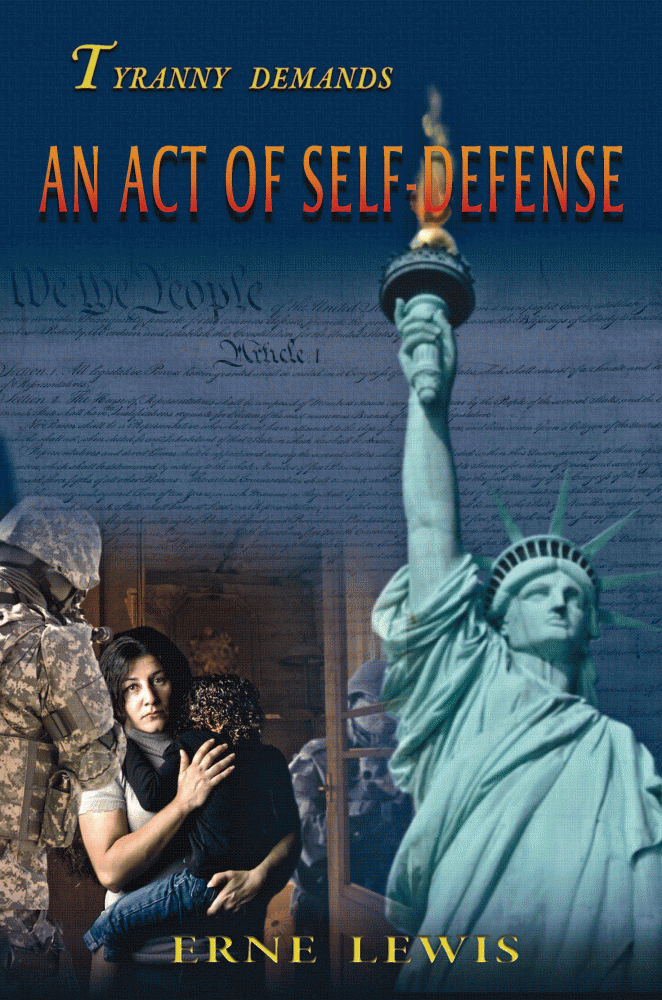
Sanctioned Murder is another of the growing genre of term limits thrillers (let's just pretend this exists, OK?) which includes Vince Flynn's Term Limits and Erne Lewis' An Act of Self Defense.

It is an easy read, a page-turner with lots of gunplay. However, I am not sure I am comfortable with the fate of the editor of the term limits blog at the center of the conspiracy. I'll try not to take it personally.

Monday, August 15, 2011

"An Act of Self-Defense" offers literal take on term limits revolution

Readers of Erne Lewis' "An Act of Self-Defense" who have also read Vince Flynn's "Term Limits" will not be able to help comparing the two. For one thing, both novels revolve around frustrated Americans who target -- literally -- Congress members in a revolutionary attempt to get the federal government under control.

In Lewis' version, the four-person rebel cadre call themselves the Term Limits Revolution and threaten to kill one Congress member per day until a 8-year term limits amendment is passed and sent to the states for ratification. Once they do that, the TLR promised to stand down and the states are free to ratify or reject it.

In the TLR's initial threat to Congress, they argue "Thomas Jefferson believed the failure to include term limits in the Constitution was a fatal error. He predicted another revolution would be necessary to regain the individual rights lost to the power-loving politicians who would, over time, increase their power at the cost of our liberty. Jefferson could not have foreseen that the federal government would today be capable of tracking our every move and communication..."

This last sentence provides much of the suspense that makes this Lewis' first novel a page-turner. The book shows, rather dramatically, how the Patriot Act and other Congressional excesses can be used not only to track down legitimate threats like the TLR, but also misused to harrass innocent Americans by overly aggressive law enforcement or, worse, for purely political reasons.

In one dramatic example, a no-knock warrantless raid on the president of a national term limits advocacy organization -- yikes! -- goes awry with tragic results. And it turns out the target of the raid had no connection or knowledge of the TLR.

Lewis has done his homework, both on the term limits issue and on the new-fangled powers government has usurped by exploiting people's fear of Muslim terrorists following 9/11.

Much like with the Flynn book, the reader finds himself identifying a little too closely with the revolutionaries. Fortunately, in the real world, we may indeed need a term limits revolution, but not one armed with guns and bombs.

Saturday, December 13, 2008

Vince Flynn's term limits of a very different kind

I had been intrigued by the title for some time, but I finally picked up and read the novel Term Limits by Vince Flynn (Simon & Schuster, 1997).

In this fast-paced political action thriller on the Tom Clancy mold, a secret group of American ex-commandos publish a list of demands and start assassinating Congress members who defy them. Their demands are of a sort that the Club for Growth might make, sans sniper fire, such as reducing spending, freezing taxes, balancing the budget and -- my favorite -- using zero-based budgeting. Ha!

If those sound like far-fetched terrorist demands, just wait until you find out how a corrupt White House decides to fight back. By the end of the book, you will find yourself thinking the terrorists are the good guys, particularly when they issue challenges like this one: "Do not test us again or we will be forced to impose more term limits."

Needless to say, the term limits of the title are not the same kind promoted by this blog. But that's not to say there were no real-world political lessons in this book. In fact, Flynn surely understands and supports term limits of a more traditional sort. Consider this exchange between a lobbyist and a young freshman Congressman:

"[Rep.] O'Rourke, if you vote no on the president's budget, the American Farmers Association will be left with no other choice than to support your opponent next year." O'Rourke shook his head and said, "Nice try, but I'm not running for a second term."

Not only does he see how term limits encourage independent thinking, but in this description of a career politician -- and assassins' target -- he also clearly sees how tenure corrupts over time:

For the last thirty-four years he'd survived scandal after scandal and hung on to that seat like a screaming child clutching his favorite toy. Fitzgerald had been a politician his entire adult life, and he knew nothing else. He'd grown numb to the day-to-day dealings of the nation's capital. The forty-plus years of lying, deceit, deal cutting, career trashing and partisan politics had been so ingrained in Fitzgerald that he not only thought his behavior was acceptable, he truly believed it was the only way to do business.

At one point, fiction and fact merge when a journalist announces.

"The assassinations have thust into the spotlight some reforms that the American people have endorsed for some time. The idea of term limits has an approval rating of almost 90 percent."

In sum, Term Limits is guilty-pleasure reading for frustrated fiscal conservatives who like action movies. If that describes you, you may wish to pick up the paperback version of this New York Times bestseller, still in print.